What Royal Chest Offers
Three core systems, each built on one concrete idea: matching symbols on treasure chests is all you need.
48 Handcrafted Chests
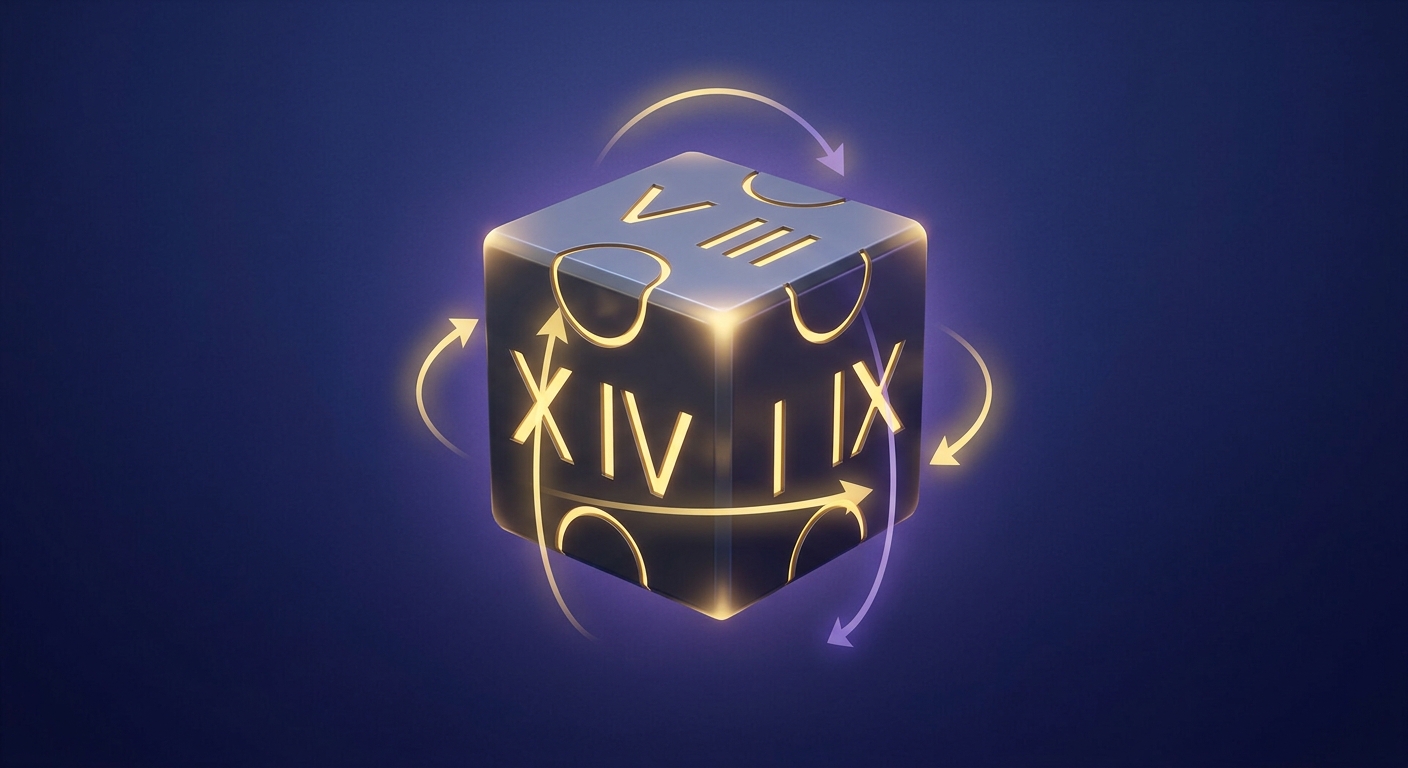
Royal Chest ships with 48 levels, and every one of them was designed entirely by hand. There is no procedural generation, no algorithm filling space between "real" levels. That matters because handcrafted puzzles can be tuned for a specific experience: we control exactly when a new concept is introduced, how long you practice it, and when it combines with something you already know.
The levels are split into four difficulty bands. The first band (levels 1–12) introduces the core mechanic with a single chest and simple symbols. You rotate and drag until three matching symbols sit next to each other on the chest surface, and that unlocks it. Most players clear these levels in under three minutes each, and that is intentional — you are building muscle memory for the controls.
The second band (levels 13–24) adds a second chest and introduces coordinated matching. Now you need to align symbols across two chests at the same time. The chests share a spatial relationship: matching on one can move pieces on the other depending on how they are connected. This is where most players report that the game "clicks" and the spatial reasoning side becomes genuinely interesting.
The third band (levels 25–36) brings in chests with asymmetric weight distribution. Chests no longer respond identically to the same input — a heavy chest overshoots where a light one stops short. You have to learn the physical character of each chest before attempting precise matches. This band takes most players about 40% longer than the previous one.
The fourth band (levels 37–48) combines everything. Coordination across multiple chests, variable physics, and levels where the solution requires looking at the puzzle from an angle that is not obvious at first glance. These are the levels testers spent the most time on and reported the greatest satisfaction from solving.
What is not included: a hint system, a level-skip button, or adaptive difficulty. Levels are fixed and the challenge is the same for every player. I believe that produces a more honest — and ultimately more satisfying — experience, though I understand it is not for everyone.
Price: Free. All 48 levels available from the moment you download. No paid DLC, no premium version.
Symbol Matching Mechanics
Royal Chest's control system uses a single action (drag and rotate) to manipulate the treasure chests on any axis. That simplicity is deliberate. I tested multi-gesture schemes during development and they turned out to distract from the spatial reasoning that is the heart of the game.
What makes the controls interesting is the physics layer underneath. Every chest in the game has a mass value that affects two things: how quickly it responds to your input and how much inertia it keeps after you lift your finger. A heavy wrought-iron chest (mass value around 8.0 on our internal scale) needs a deliberate, slower drag to turn, and keeps moving for about a second and a half after you let go. A light cedar-wood chest (mass value around 2.5) responds almost instantly but stops quickly when you release, giving you precise control at the cost of speed.
That creates a real skill dimension. In easy levels you can spin chests quickly and align symbols roughly. In hard levels, the precision required means you have to plan every move carefully, anticipating inertia and drift. Several testers told me that learning to "feel" the weight of each chest became the most satisfying part of the game — even more than the puzzles themselves.
The physics also interacts with the edges of the play space. Chests bounce lightly off the borders, which can be used to nudge a symbol into its final position if you time it right. That started as a bug in early builds and I decided to keep it because it added a satisfying, slightly unpredictable element to the advanced levels.
What is not included: custom control mapping, sensitivity sliders, or alternate control schemes. The single-gesture system is the only option, and we calibrated it extensively for both touchscreens and mouse input.
Supported devices: iOS 15+ (iPhone and iPad), Android 10+. Optimized for phone screens up to 5 inches.
Fully Offline and Private
Royal Chest runs entirely on your device from the moment you download it. You do not need an internet connection to play, load levels, or use any other feature. All 48 levels and every asset ship in the initial download, which comes in under 85MB on both platforms.
I made this decision early in development for two reasons. First, practical: many of my testers said they wanted a puzzle for moments when connectivity is unreliable — on the bus through tunnels, on planes, in waiting rooms with flaky Wi-Fi. Second, principle: I did not want to build an architecture that forced me to send player data to a server.
The game contains no analytics SDKs, no crash-reporting tools, no advertising frameworks, and no code that transmits information off your device. When you open Royal Chest, the only thing that happens is the game runs locally. I do not know how many people play, which levels they reach, or how long their sessions last. That information stays on your phone.
There is also no account system. No email sign-up, no social login, no cloud save. Your progress is stored in a local file on your device. If you delete the app, your progress goes with it. It is a trade-off — cloud saves are convenient — but it keeps the game simple and your data private.
What is not included: cloud sync, cross-device progress, social sharing, or multiplayer of any kind. If you switch phones, you start over.
Price: Free. No in-app purchases, no subscriptions, no ad-supported revenue model. Development is self-funded.
What Royal Chest Does Not Do
Being clear about limitations matters as much as describing features. Here is what the game does not offer:
- No multiplayer or social features. No leaderboards, friend lists, shared challenges, or competitive modes. The game is strictly single-player.
- No monetization. No ads, no in-app purchases, no battle passes, no premium currency. The game is free and stays that way.
- No hint system. I intentionally do not offer hints, guides, or solution previews. Part of the design idea is that every player reaches the solution through their own reasoning.
- No daily challenges or streaks. The game does not try to build a daily habit. Play when you want, stop when you want.
- No data collection. I do not track play sessions, collect analytics, or transmit any data from your device.
These are deliberate omissions based on testing during development. Every retention or monetization feature I tried measurably made the core puzzle experience worse. The game is what remains after all of that is taken out.